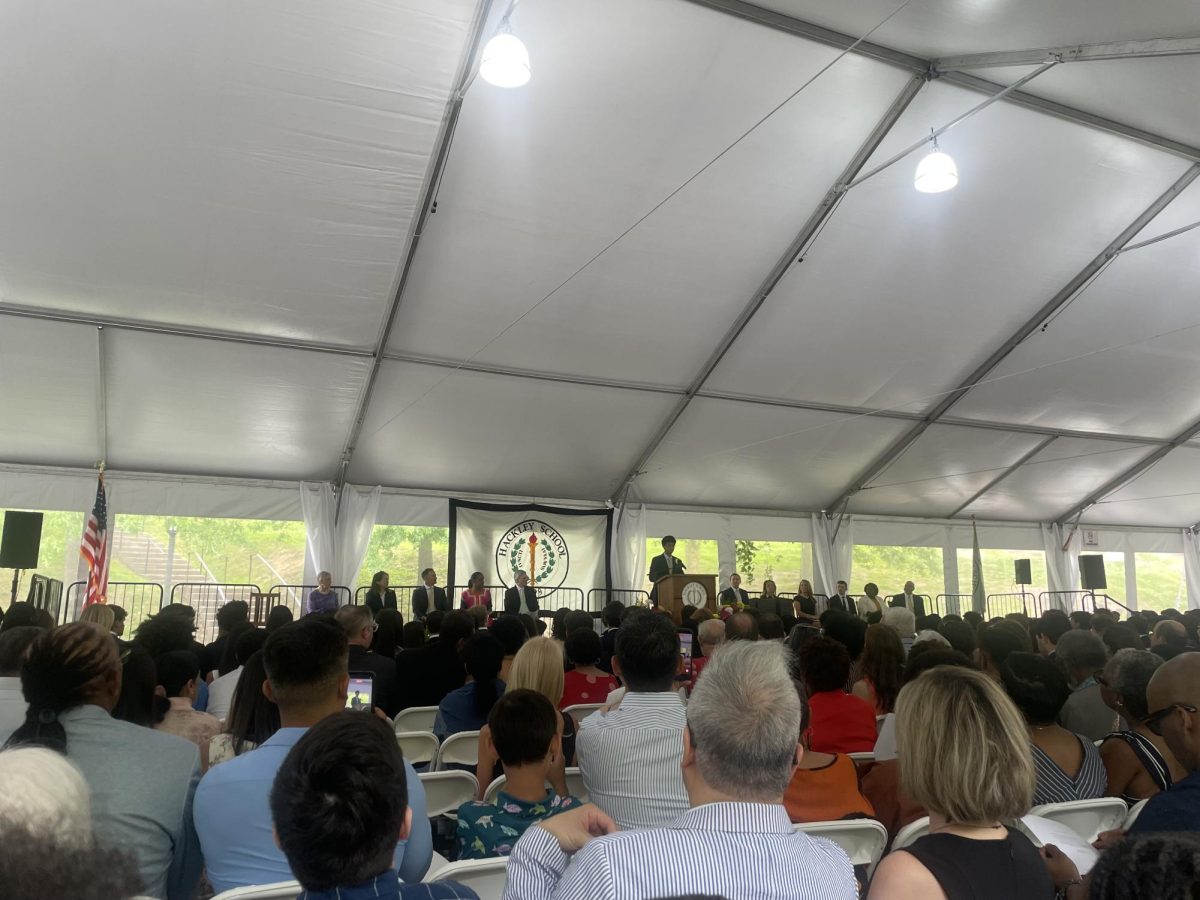
“History is a discipline that allows us to understand the world we live in and why,” said Professor Hardeep Dhillon.
Dhillon, the latest presenter in the Libert Endowed Speaker Series, spoke on immigration, the Fourteenth and Fifteenth Amendments, the Supreme Court case United States v. Wong Kim Ark, and how this history has created a legacy that affects people’s lives today.
Professor Dhillon grew up just outside Sacramento, California, and has been interested in the world of immigration since studying the topic as an undergrad at the University of California, Berkeley. Prof. Dhillon is now an Assistant Professor of Asian American History at the University of Pennsylvania.
The Libert Endowment, named in honor of Jeffrey A. Libert ‘73, provides funding and support for speakers and projects related to the education and understanding of race, law, the U.S Constitution, and how they intersect. By inviting these speakers, the History department can thoroughly explore and educate students in topics that the schedule often does not allow within each course’s curriculum, and continue to educate students on topics of the speakers’ choice.
Prof. Dhillon focused her talk on different case studies and seeing how it applies today and the message behind them.
The first case she spoke on was that of Joseph Tape, a young Chinese immigrant, who pushed the San Francisco School Board to admit his daughter to the family’s local neighborhood public school. She used Tape as a way to frame her conversation around how racial restrictions in federal naturalization law were specifically designed to undermine the Fifteenth Amendment.
To further her point, she stayed on the case of Tape, speaking on how his case against the school board made it to the California Supreme Court, incorporating the route it took to get there, particularly at the San Francisco Superior Court level. She used these cases, along with the case study of Look Tin Sing, as a frame for how racial bias existed for Asian immigrants and their children in the United States.
When looking at the cases, she noted how the precedent of former cases and other nations influenced the United States, particularly in the case of Wong Kim Ark vs. the United States.
The case follows Wong, a twenty-four-year-old man born in San Francisco.
When Wong attempted to return to San Francisco after a visit to his wife and child in China, he was detained by John H. Wise, the San Francisco customs collector charged with overseeing the arrival of all immigrants to the city.
The Supreme Court would rule 6-2 in favor of Wong Kim Ark, affirming birthright citizenship for almost all, a major emphasis in Dhillon’s speech.
“Once again, the fate of children of Chinese ancestry became contingent, in part, on the concerns over the disenfranchisement of children of European ancestry, valuing the rights of Chinese American children insofar as they were valuable to children of European ancestry,” said Dhillon.
Something Prof. Dhillon also alluded to in her talk and emphasized in her interview is how speaking to students and having conversations with them, in her classes and with students at roundtables, allows her to view topics in a new light.
“Communicating with and being updated with students allows you to view a topic in a new way,” she said. “Even if you are teaching the same sets of readings, I’ve been able to learn about how a generation thinks and processes in comparison to the year prior.”
After speaking to the Upper School, Prof. Dhillon had the opportunity to visit sections of Upper School history classes, bringing her research experience and portfolio to students at the same time they were writing their end-of-year research papers.
For students of Noah Knopf, who teaches History 9, they got to hear about the connections she made with the families of her research and descendants who didn’t even know the connection they had.
“She was really cool for [my students] to see as a model of what it looks like to care about your research and how it can make a real-world impact,” said Mr. Knopf. He also spoke on how important it was to the students in their papers as well.
“It was great for them to have someone who is not only a professional researcher (and very good at it) but is also very motivated and driven by the subject of her choice – something our students got to take away as they worked on their papers,” said Mr. Knopf.
As the years have gone by, Prof. Dhillon has seen her lectures and interactions with students evolve, particularly in response to the current political environment. For her, this has become the most pressing concern.
“The urgency has amplified in particular over the past few years; students want to learn about the world they live in,” she said.
As the political environment and rulings in immigration law change daily, something amplified in her presentation, along with in her courses, is how history is up for debate. A point emphasized in her presentation is that at every moment, the courts are wrangling with issues. This includes the justices themselves, who are weighing the decisions that have been made in the past, as a means to influence how they may rule in the future.
“We all share the world we live in, and that allows us to have meaningful and sustained conversations, and for me, history allows us to do that,” she said.