




















































Many notable movies premiered in theaters this summer, two of the most talked about being Superman, directed by James Gunn, and K-Pop Demon Hunters, created by Maggie Kang and Chris Applehans. Before watching the movies, I wondered why these two movies were so popular. Throughout the years, there have been many different Superman movies, not many of them being talked about as often as this adaptation was. I understood why KPop Demon Hunters would have been popular among younger children, with its flashy animation and bright songs, but I didn’t understand why it seemed to appeal to adults as well.
After watching and talking about the movies, I began to understand their popularity. Not only are both fantastic movies from a technical and artistic standpoint, but both also find ways of relating to their audiences with loud statements about what they are representing.
Superman resonated with most audiences who watched it, many of whom have drawn comparisons between Gunn’s adaptation of Superman and Zach Snyder’s, who was the director of the most popular modern adaptations of Superman. The main focus of discussion around the film has been comparisons between the film and the Israel-Gaza war.
Comparisons between the movie’s fictional war between Boravia and Johranpur (fictional countries) and the war between Israel and Gaza ran rampant on the internet after the movie came out. The comparisons mostly came from the film depicting a large, US-backed country attacking a smaller, largely defenseless neighbor with mainly civilians in harm’s way.
The movie ends with Superman supporting the smaller country (which many have speculated is meant to represent Gaza) and fighting for its civilians, while the president of the larger country (who many have speculated is intended to represent Israel) is dropped to his death by another hero, Hawk Girl.
While having indirect parallels to the crisis in Israel and Gaza (James Gunn has stated that any comparisons are purely coincidental), the film also provides examples of xenophobia, which is the fear or hatred of anything strange or foreign, primarily through the villain Lex Luthor. Throughout the movie, Lex Luthor refers to Superman as ‘alien’ or ‘it’. While these terms are dehumanizing by themselves, the overall viewpoint of Lex Luthor shows how harmful racism and xenophobia can be, especially coming from very influential people.
Almost immediately, the media turns against Superman, dehumanizing him, as well as influencing public bias. Lex Luthor was the main cause of this, leaking incriminating information to the media, suggesting that Superman had been sent to annihilate the human race by his parents.
KPop Demon Hunters, which discusses a different sort of hero, came out this summer as well. Instead of a hero in a cape, it shows the good that can be done through working in the shadows.
While primarily being known for becoming Netflix’s most-watched movie of all time, KPop Demon Hunters’ success has also been credited to its memorable characters, both major and minor.
The characters’ backstories and motivations are explored in depth throughout the whole movie, providing a holistic view of each character, and not painting one character as entirely bad and another as entirely good. This method works to show that circumstances can draw one side out more than the other at any given time.
Many topics that have become stigmatized in children’s TV were discussed, like body image/dysmorphia, LGBTQ+ themes and identity, generational trauma, shame and acceptance, the power of media, and mental health issues.

This infographic displays all the factors that make up a persons mental health. If enough of these factors are impacted in a negative way, their mental health begins to suffer.
As the title suggests, the main characters of the movie spend a considerable amount of time fighting demons that come from a version of hell, working to kill them before they can suck out the souls of living people. The king of the demons, Gwi-Ma, recruits demons by manipulating them into forming a pact with him, preying on their insecurities and doubts to gain their soul when they die.
In this way, each person who works for Gwi-Ma has succumbed to their personal demons to become a demon themselves, letting shame, guilt, anger, envy, etc., overtake the rest of their emotions and ambitions.
This part of the movie has been credited for being a positive representation of mental health and how those around the people suffering can effectively help them.
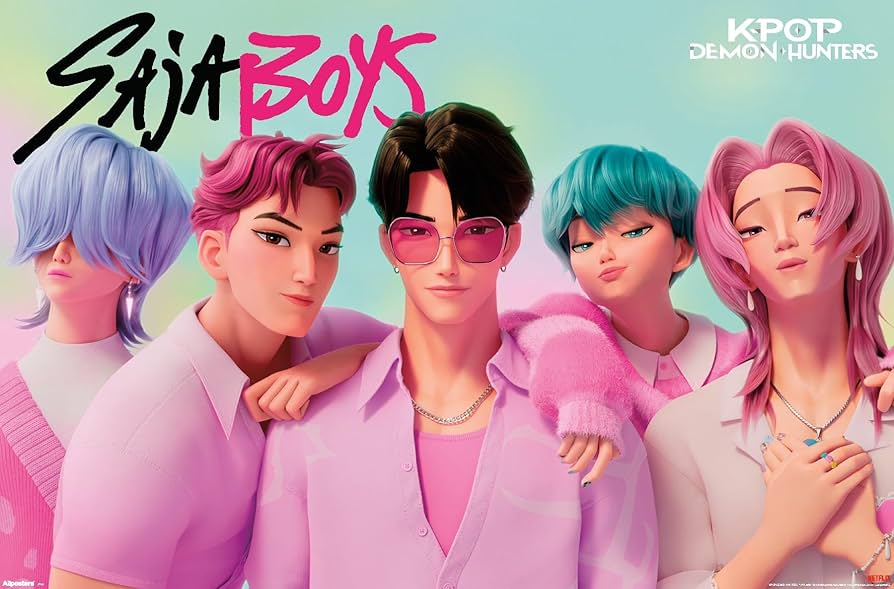
The movie features two main groups. Huntrix, the demon hunters, and the Saja Boys, the demons. Huntrix provides a narrative on how people suffering from mental illnesses can be supported by those around them. The Saja Boys display what happens when a person or the people around them ignore their declining mental health, and what people will turn to to try and fix a situation.
Huntrix shows how flawed ideas about mental health can be overcome and dismissed in favor of methods that would support the person who is being affected. Throughout the movie, the members repeat what their mentor told them: “Our faults and fears must never be seen.” This goes along with misconceptions about mental health, that, in ignoring or suppressing the issue, it would disappear.
As shown through one of the members, Rumi, suppressing emotions and issues is highly ineffective as it can lead to isolation and shame, compounding on top of the already existing issue that is being covered up.
Throughout the movie, the members of Huntrix learn to be more honest and open with one another, sharing their fears and doubts and accepting one another’s confessions with kindness and acceptance. They learn to reject people and ideas that were unsupportive and to find healthy coping mechanisms that would let them heal. They learn that sharing issues and thoughts can lead to a support system that lets everybody heal and rely on each other, instead of creating an atmosphere of isolation and suffocation.
This method is more in line with what is being taught by most mental health professionals today. It has been proven that stoicism and suppression do not make the issue better; in fact, it seems to worsen the issue in the long run.
This is shown through the Saja Boys. The Saja Boys are depicted as demons, which in this universe means that they made a deal with Gwi-Ma, their king, to give him their soul in death in exchange for a reprieve of pain in life.
This is a metaphor for harmful coping mechanisms that are commonly used to deal with issues stemming from mental health problems, like drinking, smoking, or self-destruction.
A primary example of this is the leader of the group, Jinu. In life, he sacrificed his soul to Gwi-Ma to escape poverty, leaving his mother and sister to die. Later on in his time as a demon, he meets Rumi, who is the first person to listen to his story without mocking him. While Rumi is trying to help Jinu, he is spiraling in grief and guilt over his past actions, and he ends the movie dying.
In this way, the movie shows how Jinu is a good example of somebody helped too late, while Rumi was somebody who was saved in time.
Combined, these two movies provide an interesting narrative on the state of the world today.
The movies connect through discussing similar themes. Superman displays how a supportive community and positive upbringing can impact someone’s worldview and how they solve issues. KPop Demon Hunters discusses how preconceived biases about a certain group of people, similar to xenophobia, can impact the way they fit into society.
They are also connected to the real world as well, with Superman discussing the racism and stigmatization of groups of people based on biases or false news, while KPop Demon Hunters discusses the effects this treatment can have on people, displaying the mental toll a person will suffer in this environment. While these two movies became known for their production, they were ultimately influential because of their study of real world issues, and their ability to genuinely connect to people.