



















































What makes a person guilty? Is justice that separate from revenge? These questions ignited a fatigued tenth-grade English class in argument.
The Stranger, by Albert Camus, was introduced this year as a new book for the tenth grade. For a book that is seemingly so detached from the usual student and human experience, it had an abnormally strong impact on many students. Why is this? And, are we actually so different from the characters and themes presented?
The beginning of the last period on a Thursday was languid. The air was stagnant, and the lethargy was tangible. It was not a day that should have led to a cacophony of students’ voices.
I read the chapter back during the room’s stillness.
In chapter four, part two of the book, two quotes caught my attention: “…were their two speeches so different after all?” and “…a man who is morally guilty of killing his mother severs himself from society in the same way as the man who raises a murderous hand against the father who begat him,” Camus writes.
My mind was battered by a sudden realization: what is the difference between any of these characters? What is the difference between a guilty and an innocent man if they have the same traits?
I shared my questions with the class, only to be met with stares across the room. Many brought up that one killed a man, and the others did not. I said that they are convicting the main character, Meursault, of premeditated murder, but they themselves are planning on killing him. What is the difference?
Someone shouted across the room that the prosecutor hads a reason for killing Meursault, like an eye for an eye. I kept quiet.
Questions and answers bounced loudly from person to person. I was rolling the “reason” question over in my head. What if Meursault had a “reason” for killing the man? How is that different from the prosecutor having a “reason” for killing Meursault? What is the difference between justice and revenge, especially if that “justice” means taking a life?
My teacher, Aidan Wolff-King, interjects as the conversation keeps growing. He offers a question to the eager class: if the man Meursault killed was your father, what would change if you killed Meursault?
Students yelled that it was for justice and to stop Meursault from doing it again. Mx. Wolff-King said that then you would be killing a man for a crime he has not yet committed.
The issue with that is greater than justice. What if Meursault did not actually kill the man? Is Meursault also being murdered in that case?
I spoke again. I said that then the prosecutor should be put to death as well because he is planning on killing Meursault. If Meursault is dead for a crime he might have committed again, how do we know that the prosecutor will not call to execute someone again?
My watch lit up. It is 3:12 pm. We have never stayed late, ever, and most of the students had not noticed.
The conversation lulled soon after. I was left with more questions than answers.
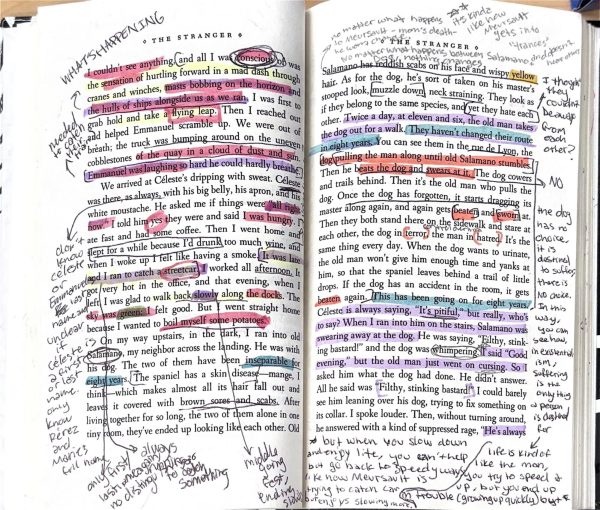
The book’s explicitness invites the reader to make more obvious connections at a deeper level. Annotations are a projection of someone’s thoughts, and even if a student does not make as meticulous notes, the ideas and thoughts surrounding the book are no less prominent.
I was accustomed to leaving questions surrounding this book unanswered, but I never could feel completely at ease leaving it alone.
But, there was one question that lingered longer than the rest: what about The Stranger can revive a class last period on a Thursday?
This mystery was only solved when I was left in tears after watching Wes Anderson’s The Darjeeling Limited.
The movie follows three alienated brothers, Francis, Peter, and Jack, who agree to meet in India to go on a spiritual journey.
Near the conclusion of the movie, the brothers attempt to rescue three young boys who had fallen into a fast-moving river. Francis and Jack are able to save two of the boys, but Peter’s boy is killed by the current.
Peter carries the boy out and says to his brothers, “I didn’t save mine.”
In my sorrow, I was immediately transported to a line in The Stranger. Meursault’s elderly neighbor, Salamano, loses his dog and says to Meursault, “‘I hope the dogs don’t bark tonight. I always think it’s mine.’”
Both lines forced me to have empathy for two tragically flawed characters. It also made me believe that these imperfect characters cared, despite not specifying it. Peter went on the trip without telling his wife, who was nine months pregnant, and seemed to be angry at the fact that he was going to be a father. Salamano, more violently, abused his dog for years.
Despite this, both characters are deeply human. Peter fears becoming a dad and displays that emotion as anger or indifference. Salamano uses the dog as a mirror for himself. Both he and the dog have “wispy yellow hair” and scabs covering their faces. Meursault even says, “they look as if they belong to the same species…”. This indicates that Salamano is profoundly unhappy with himself and, like Peter, projects it in different ways.
These layers do not make the characters any less flawed; it makes them human and three-dimensional.
The Stranger is so compelling because it spells out what movies and humans do more discreetly.
With Peter and Salamano, Salamano’s story makes it blatantly obvious that the dog is a reflection of himself, while this analogy is more inconspicuous in Peter’s story.
The Stranger also expounds themes common to almost all flawed or villainous characters.
Why do you feel empathy for a villain? Because they have layers, motivations, and lives before villainy. This is the part obvious in movies.
But behind it all lives a core question for these villains: what is the difference between justice and revenge?
Take Scream, for example: the killer, Ghostface, kills the mom of the main character, Sidney, because she was cheating with his dad.
Though this example is more extreme, given the movie’s “slasher film” genre, Ghostface, with his original murder, blurs the line between justice and revenge. Justice for his mom, who was being cheated on, or revenge for the affair ruining his life?
In many other ways too, The Stranger takes these discreet motivations and elucidates them, allowing the reader to understand these complex themes that are seen constantly throughout life.
The Stranger is a textbook for the questions and themes that guide everyone’s stories. This is the reason my English class was so enraptured by the book. Because in an imperceptible way, they relate to the book, too; everyone can.
