

























Science class often conjures images of complex physics equations and elements on the periodic table. Imagine you could actually spend periods studying bird calls or hiking through the woods while observing leaf patterns. Hackley’s Applied Forest Ecology Research (AFER) course makes this dream a reality.
AFER is an elective taught by science teacher Tessa Johnson that focuses on Hackley’s forest ecosystem and how we can manage it. Through long-term data collection projects and extensive research on the local wildlife, students are able to understand how Hackley’s environment is changing and find ways to improve it. Instead of memorizing equations, students learn how to observe the nature around them and make a positive impact on their communities.
“The point of the class is to develop a naturalist language. There’s so much happening outside, and a lot of people are nature blind because they don’t understand their environment. Once they learn about it, though, they realize how prominent nature is and that its lessons are applicable wherever you go,” Mrs. Johnson said.
Rooted in history, AFER has been taught for many years at Hackley. While many parts of the class have evolved as times have progressed, including its name, some traditions still remain. During the first trimester, students spend a lot of their time creating naturalist binders where they record and observe a vast amount of leaves, plants, and other parts of Hackley’s ecosystem.
“Before technology, people would go out into the woods, take plant pressings, and write notes about each plant to observe what was what. Down in the archives, we actually have John Van Leer’s binder, a previous student and teacher at Hackley. The binder project is a longstanding tradition at Hackley, and it’s very cool that it’s something we continue to do even as time goes on,” Mrs. Johnson said.
The hands-on nature of the course is one of the things that differentiates AFER from other classes. Rather than studying in the classroom, students travel around Hackley’s campus to observe the wildlife and land around them. Getting to roam through the Hackley forest, wade through the pond, and hike the trails are just a few of the activities students get to do as members of the class.
“Last year, one of my students said something really interesting. He was like, Do we ever take notes in here? The answer to this question was mostly no, because we learn differently: by being outside,” said Mrs. Johnson.
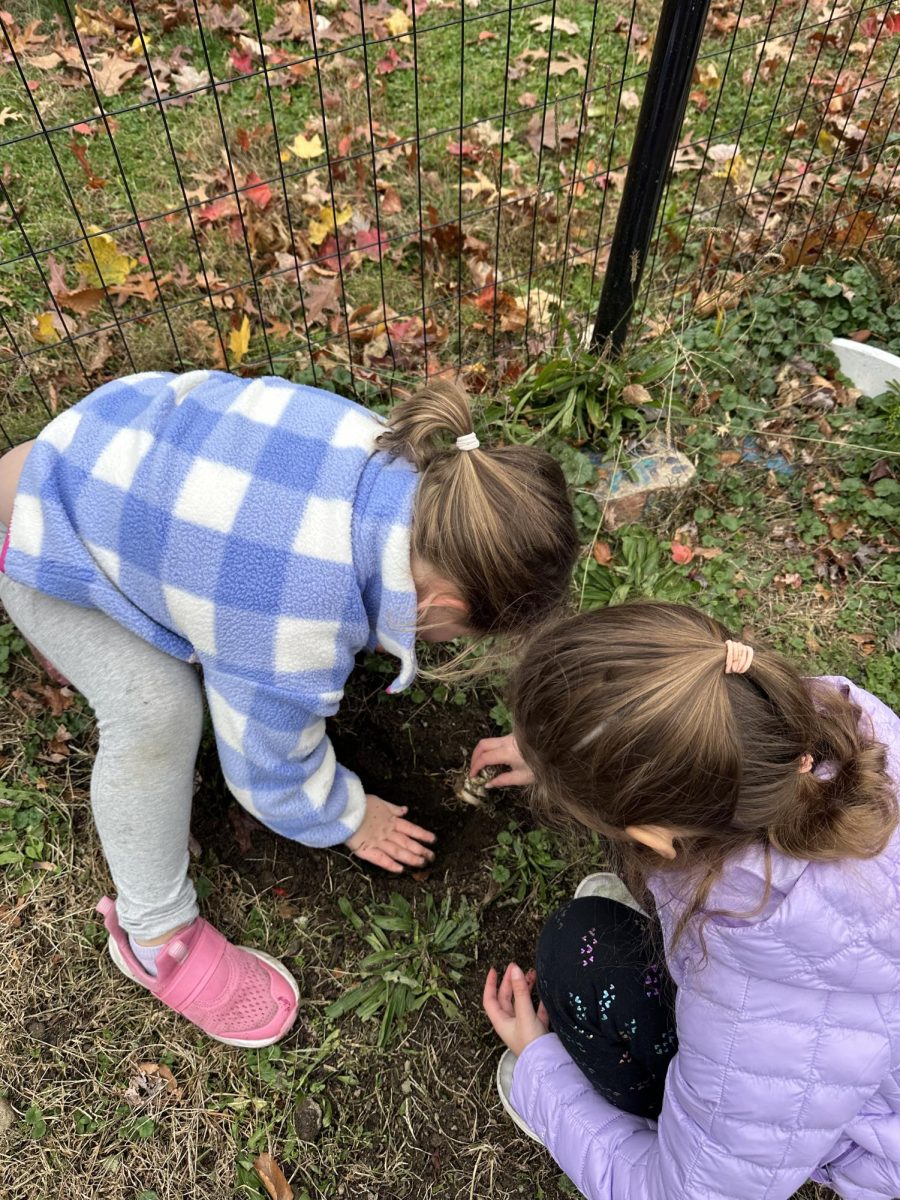
Another key aspect of the course is its year-long collaboration with the kindergarteners. Each member of the class is paired with one or two kindergarten buddies, whom they meet with once a cycle. They complete activities ranging from owl calling to hiking and bulb planting, getting to build bonds with the younger students while helping them learn about nature.
“When meeting with the kindergarteners, the older students really get to become the teachers and foster a sense of comfort in the classroom, which is very awesome to see,” Mrs. Johnson said.
While the buddy system is currently running strong, it has greatly evolved over the past ten years. What was once monthly meetings has transformed into weekly collaborations, enriching both the older students and kindergarteners’ lives.
“As a lifer, I barely remember my AFER buddy because back in the day, there was less collaboration, but I do remember looking up to them. Now that I’m a senior and we meet with our buddies constantly, it’s really nice that we get to make a positive impact on their Hackley experiences, and it’s cool how it came full circle,” said senior JP Ngbokoli.
Simply getting outside each day and getting the chance to catch a breath of fresh air is another thing that makes the course so special. Especially during stress-inducing times like high school, it is super important to step back and breathe.
“Going outside is so rejuvenating. By the time we come back inside from our activities, the students all feel very refreshed. It’s a great mind reset to step outside once a day,” Mrs. Johnson said.
In a world where our ecosystem is constantly evolving, having the ability to learn about all of the factors that harm it, like invasive species and climate change, is also extremely rewarding. With the students’ newfound knowledge, they have the opportunity to help save our environment and inform others about its troubles one step at a time.
“Now that I’m more informed about the ecosystem around us and all of the factors that are harming it, I would be interested in trying to find ways to make a difference not only in the Hackley forests but also in the greater world,” senior PJ McCaffery said.
By working alongside younger students and venturing through Hackley’s campus, AFER is an environment that emphasizes exploration over observation.