











































Dressing for the Weather: More Complicated than it Sounds
The shift from fall to winter is marked by the falling of leaves, the change in time, and, most notably, the change in temperature. Everyone in places that face a drastic change in temperature has to accommodate for their surroundings, incorporating layers and time for breaking ice or shoveling snow into their schedules.
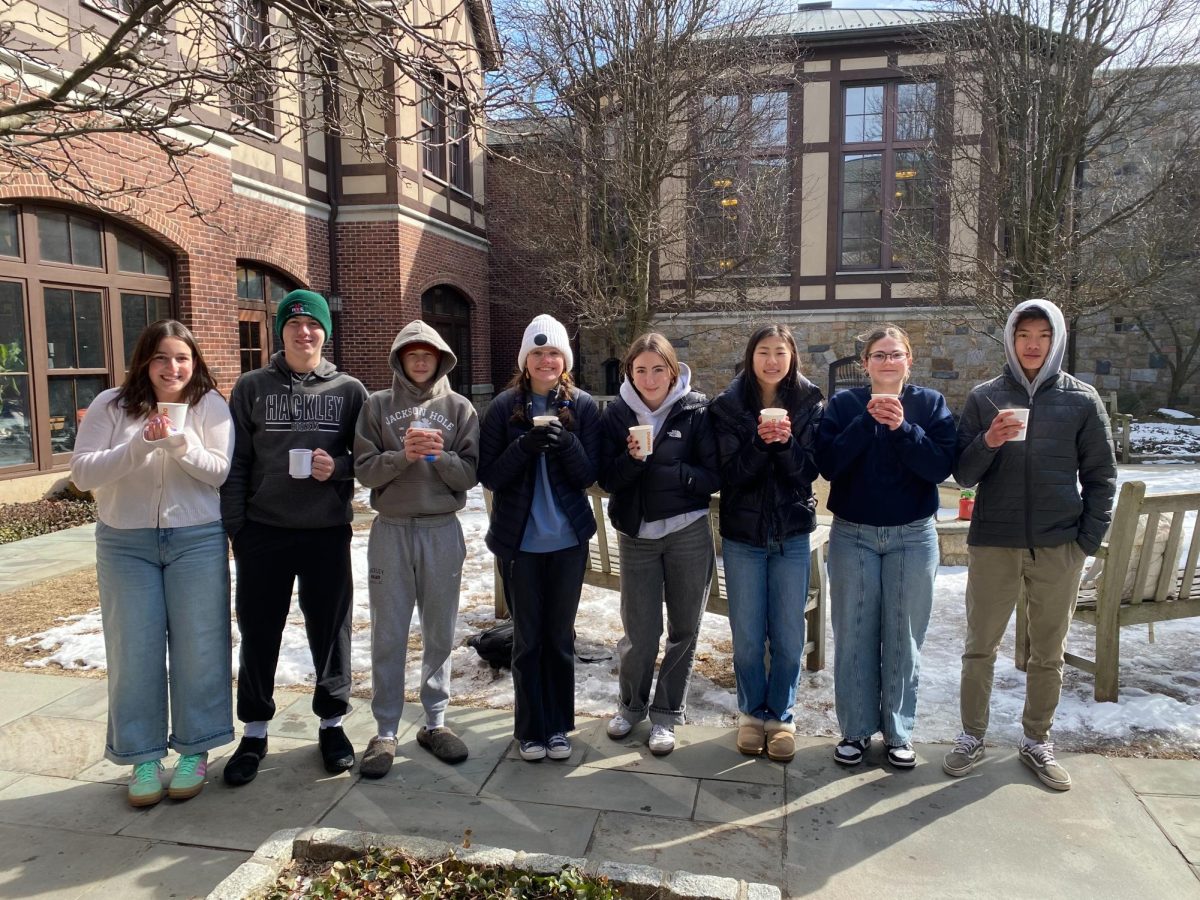
The effect of the weather impacts how students dress. With various schedules that take them to various places, a classroom of students can look both hilarious and bizarre.
Schedules are a big part of why the dress in Hackley can appear strange during the transition from fall to winter. Some students could be wearing short-sleeve shirts and loose pants, while others will be bundled up in sweaters, hats, and jackets.
This change in temperature can impact many of the students and faculty at Hackley, as many of them have to walk across campus outside to get to classes, meetings, or other commitments.
The Issue with an Outdoor Campus
Additions to schedules, such as commitments in the Center for Creative Arts and Technology (CCAT) or the Johnson Center, which can be a 5-minute walk from other parts of the campus, can make a day feel more daunting than it would have otherwise.
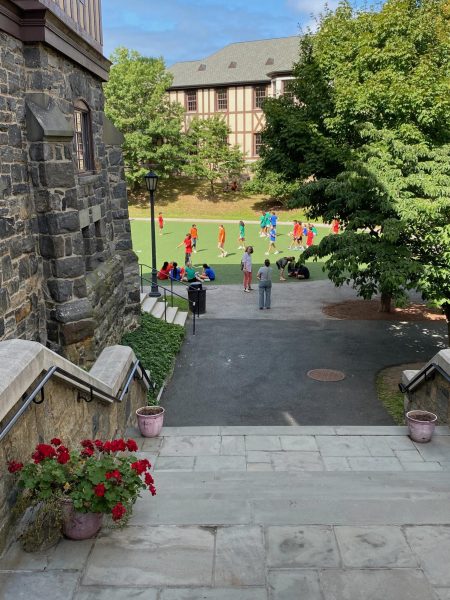
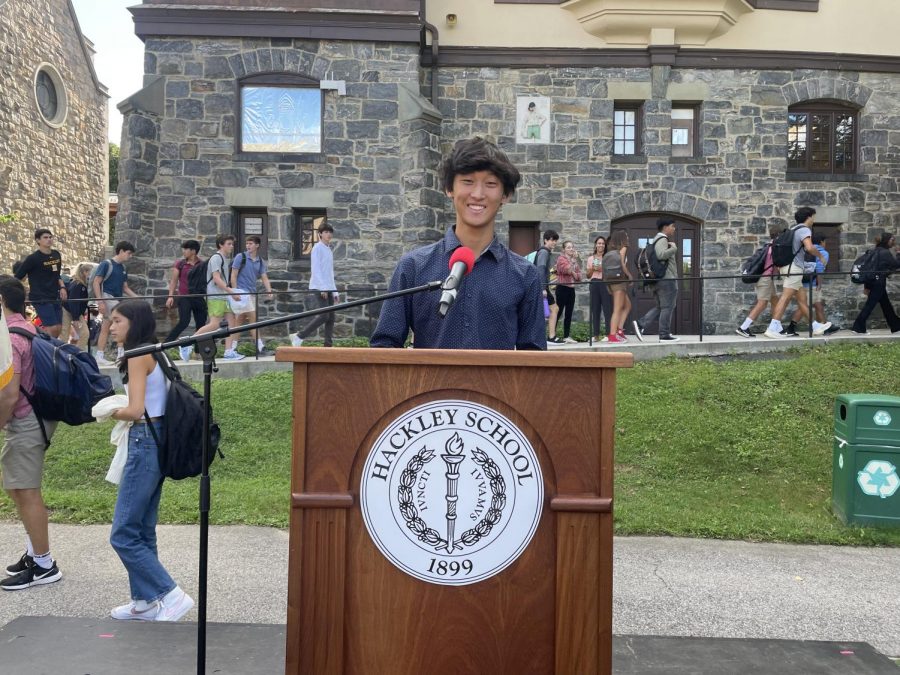
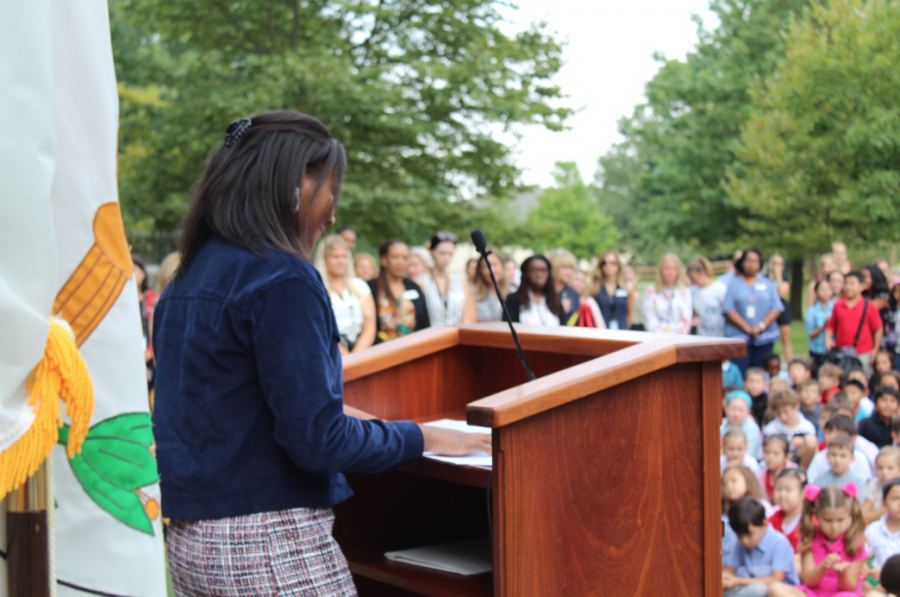
Hackley’s campus in early September, a couple of days after school started. Shown here is Akin common, with some of Hackley’s younger students and their teachers outside. The students can be seen wearing short sleeves and shorts, showing how warm the temperature is.
Schedules fall so that on certain days, a portion of students would have the opportunity to stay in one building all day, while others might have to go across the campus from the Johnson Center to the Center for Creative Arts and Technology (CCAT), sometimes multiple times per day.
Mrs. Sekkas, a health teacher whose classroom is in the Johnson Center, said, “That walk [from the main campus to Johnson Center] is brutal, isn’t it? All the wind and water make the stairs slippery.”
There is also the additional factor of trips between classes, from buildings closer in distance. There is one part of campus, the walkway through Kroger Arch, that sophomore Finlney Wiles affectionately labeled “the wind tunnel.” During windy days, that walkway can become at its best unpleasant, and at its worst slightly terrifying to walk on, especially if there is long, loose hair or papers involved.
The Issue with Extra Clothing and the Heating in Classrooms
This contrast is funny, but the difference in temperature can cause a problem for students. The fight between parents and students over wearing a jacket to school is common. While there are obvious pros to wearing a jacket, such as avoiding sickness and discomfort, there are also cons, especially for students.
A jacket is bulky and takes up space in backpacks and lockers, and sometimes that is not space that can afford to be lost. The jacket either has to be worn throughout the day or lugged around through classes and lunch.
While wearing a jacket throughout the day would not normally prove an issue, the warm temperature in classes can lead to discomfort. There are two classrooms in particular that have a notable change in temperature, room G113 and room G207.
G113 is an English classroom where Mr. Knopf is currently teaching grade 10 English. Its temperature can vary wildly from day to day. At times, it will be boiling hot, and the windows will be opened, despite the fact that it could be thirty to forty degrees outside. On other days, the air conditioning is on full blast, leading students to scoot away from the vents on the floor or tuck their hands into sleeves, hoping to preserve warmth.
Hilaj Shklarski, a sophomore who has class in room G113, has worn her winter jacket through many classes in the room.
“It’s always cold there. I don’t know why the windows are always open. We can deal with the heat; the cold is worse,” she said.
G207 is a Math classroom located near the library, and it is almost the opposite of room G113. It is mainly boiling hot, and throughout the course of the class, multiple students take off their jackets or put up their hair, hoping to let some heat off their necks. In some cases, students in previous classes have requested to have the window open, as the warm atmosphere can make some students tired. When the window is closed at the beginning of the next class, it takes more or less 5 minutes for the room to heat up again.
Cathy Lyu, a student who has class in room G207, has felt the change in temperature as well. She said, “Why is it so cold out here?” when walking from the heated classroom to the cooler halls.
Transitioning from one of these rooms to another can be a shock, pleasant or unpleasant based on the person. In any case, it makes the day interesting for some and mildly unpleasant for others.
The Issue Inside the Buildings
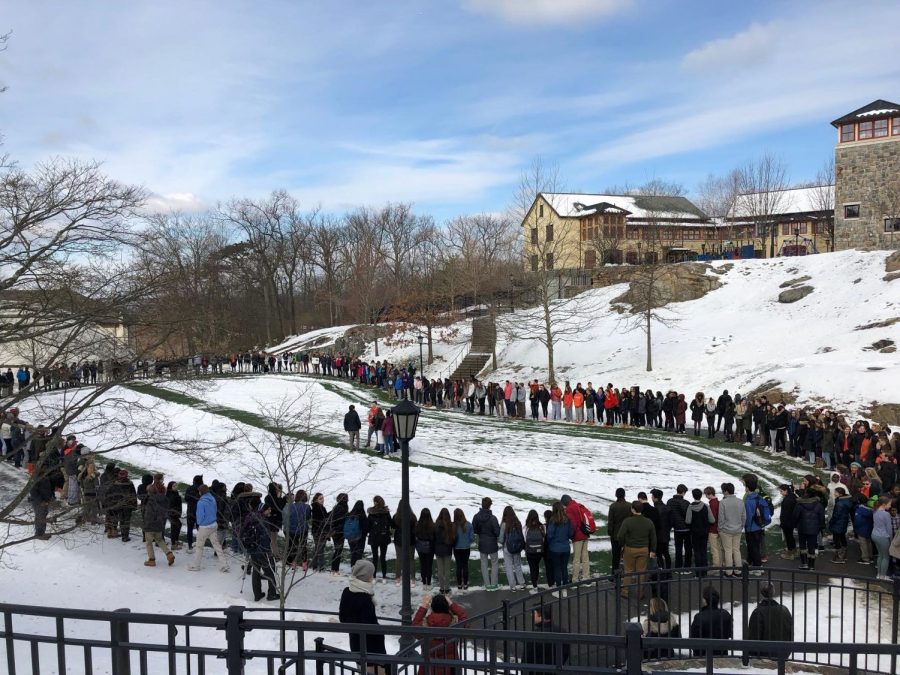
When the weather becomes bad, and Hackley remains open, the outside campus can become more and more unpleasant. Ice can make walkways slippery, and snow and water tracked in from outside lead to an increased number of accidents on stairwells and hallways, especially in between periods when multiple people are tracking water through the school.
The CCAT is a place that is affected by the change in weather, especially when it is raining or snowing. Every Friday, when the school assembles in Diller Hall, the stairs get slippery, which leads to some accidents.
“I remember falling with my backpack last year,” sophomore Franklin Truong said. “It wasn’t too embarrassing because there was no one around, but it hurt.”
Temperature on campus can influence clothing choice, falling up or down stairs, and impact divisions of space in backpacks or lockers, taken up or left empty by jackets. The temperature variations pose a problem because of the discomfort they cause, but they can also bring a source of lightheartedness and amusement to campus that can be missing during the winter months.