

























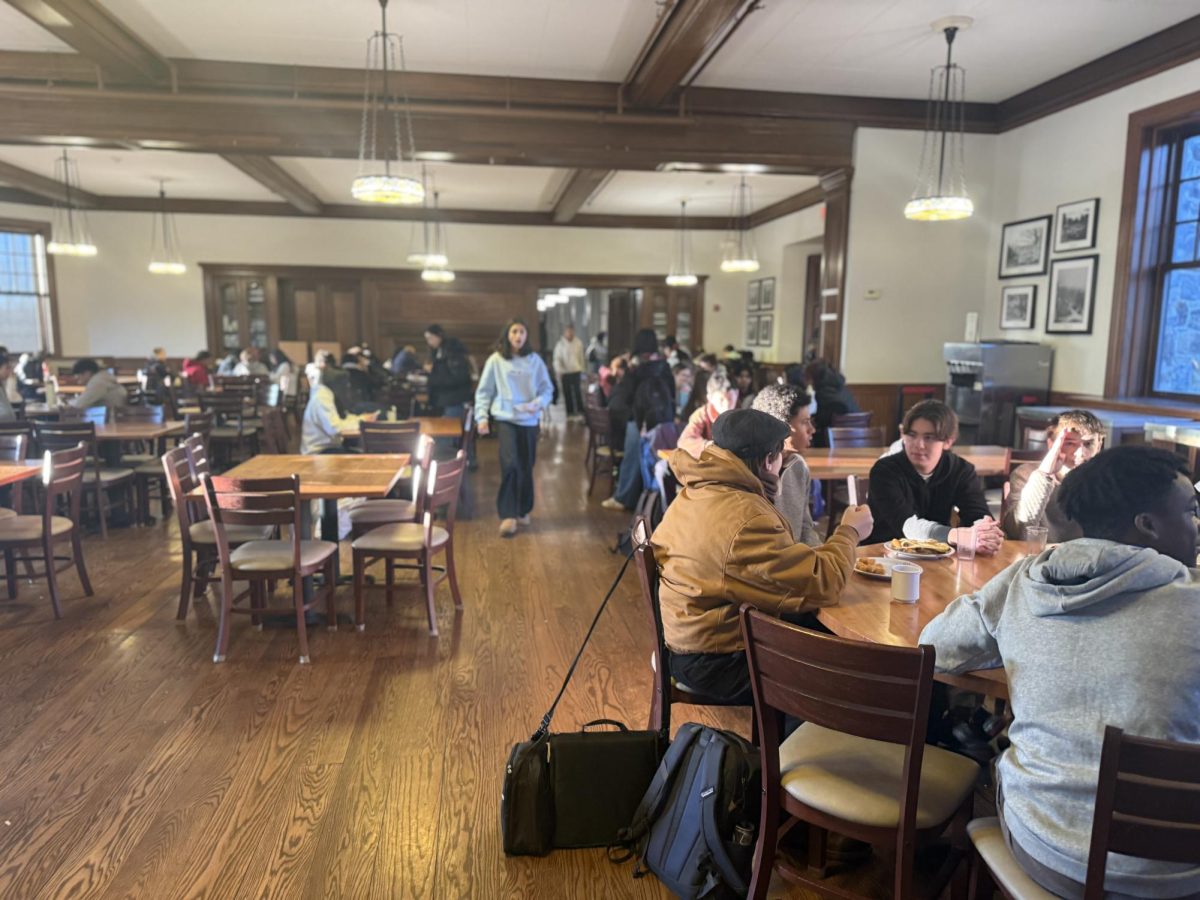
If you’ve ever eaten a meal at Hackley, you have likely noticed that food waste is quite common. Students consistently throw out entire plates of food, and garbage cans fill up rapidly. Like at schools all around the world, many teachers and administrators are working tirelessly with cafeteria staff at FLIK Hospitality Group (the food service company at Hackley) to optimize food usage.
Studies show that one-third of the food produced in the US is wasted, leading to increased methane emissions from landfills. Food waste in schools is even higher.
According to Pennsylvania State University researchers, 27% to 53% of the food served” at schools in the United States was wasted. This can be attributed to a variety of reasons. The same study found that students will predictably discard most of their “healthy” foods, such as fruits and vegetables. This accounted for more than 50% of their waste.
Interestingly, faculty wasted nearly as much in these categories, with 43% of their fruits and vegetables being thrown away.
Daniel Lynch, the executive chef from FLIK, said that they prepare about 300 meals for breakfast, 1100 for lunch, and probably 300 again for dinner. This adds up to roughly 1700 meals each day, and hundreds of thousands a year.
With so much food being produced, there is ample room for waste. For example, any food that is set out (salad bar, bread, spreads, etc.) must be discarded for sanitary reasons. In November alone, FLIK recorded 1070 pounds of food waste, resulting in 2.4 tons of CO2 emissions. Additionally, 106,000 gallons of water were wasted during this time.
Still, FLIK implements ways to reduce these numbers. One way they do so is by repurposing unserved food. For example, they often use leftover chicken in the next day’s soup or salad. Another way FLIK staff reduce waste is by predicting how many people will be eating that day, thereby minimizing leftovers.
No matter how much work administrators do to minimize food waste at Hackley, consumers will always play the largest role in this issue in the choices they make. Students often don’t pay attention to their food waste.
“When I go to put my plate away, I see large amounts of food in both the garbage and compost bins,” said Sophomore Tian Cheng Wu.
He agrees this is a problem, but he doesn’t think about it much because it doesn’t impact his daily life.
“While it doesn’t inherently affect me, it does kind of disrespect the people who grew, processed, transported, and cooked the food to make it available for us,” Tian Cheng said.
Another Sophomore, Zaira Sammi, shared a similar sentiment.
“I do feel like I contribute to the problem,” Zaira said.
She, too, knows and understands the effects of food waste, yet she continues to act the same way. Neither she nor Tian Cheng is a bad or inconsiderate person, so why do students like them continue to do this?
It seems like students don’t consider just how detrimental food waste may be.
Hackley’s HEAL Club (Hackley Earth Action League) helps to combat this problem. HEAL is a club dedicated to raising awareness about environmental issues on Hackley’s campus, with food waste being one of these issues. They organize events to help educate students on the harms of food waste from the perspective of climate change. These events range from presentations to Kahoots.
Still, “that’s definitely something [they’ve] run up against, said Regina DiStefano, science teacher and the advisor for HEAL.
Ms. DiStefano admitted that getting people to change their cafeteria habits has been “challenging” and doesn’t quite know how to make a change.
Ms. DiStefano also noted that these HEAL club events didn’t happen last year because they “got so much pushback about it,” indicating to her that people wanted a break from the topic.
Sometimes students struggle with food waste initiatives because they don’t feel like it’s an important enough topic on which to concentrate. This indifference is seen in the cafeteria, too. Most students recognize their waste, but few are worried enough about it to change their behavior.
Ms. DiStefano mentioned that it is very important for people to continue to talk about these issues, with the goal of reducing food waste. To succeed, she believes it is vital to find a balance in the way that information is delivered so that people hear the message and take action, instead of being turned away from the movement
Clearly, food waste is a problem in our community, which isn’t fully unsolvable. There will always be food that could be eaten that ends up in landfills. Still, this problem can and is being minimized daily through the FLIK staff’s constant effort and an increase in student awareness. As a community, there is still room for improvement.