




























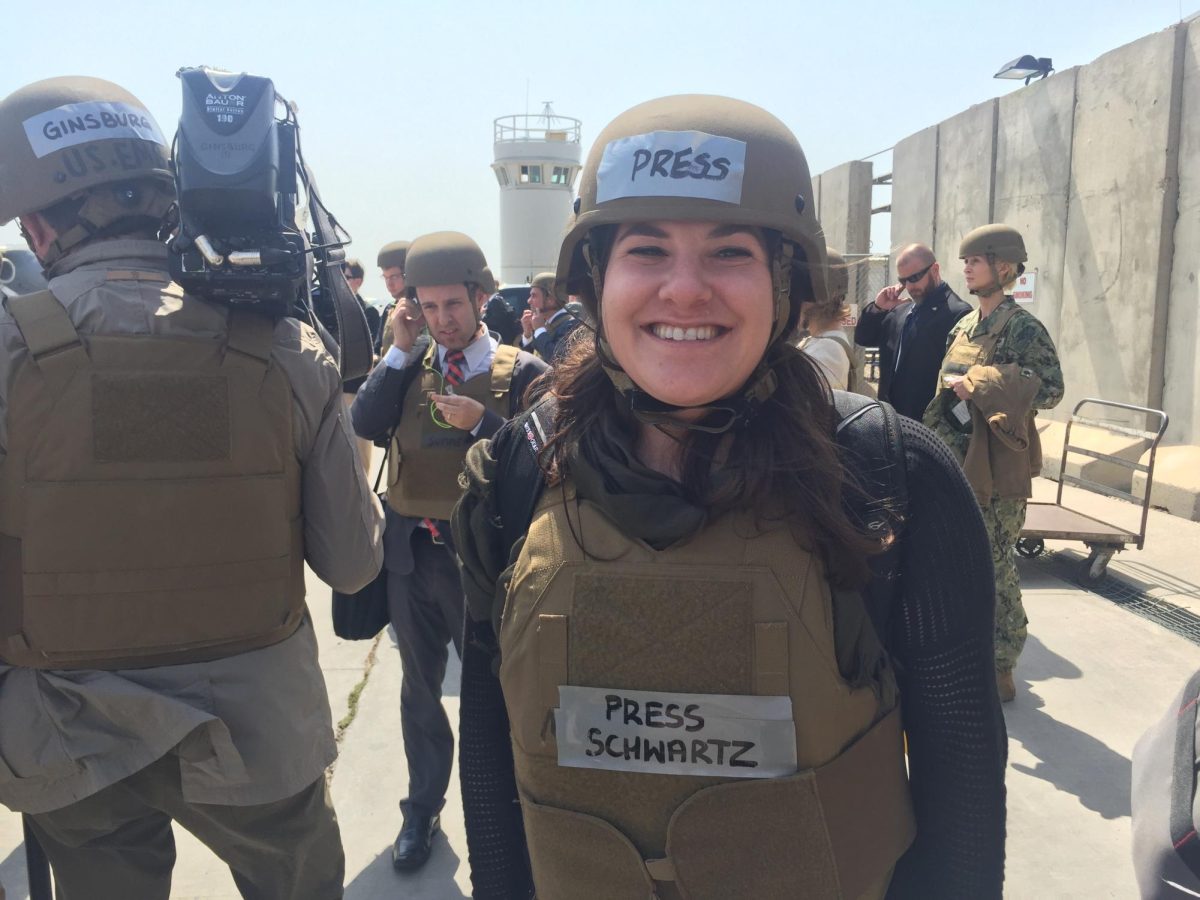
For most people, if the sitting Vice President publicly jabbed them, it would feel like the end of the world. However, for Felicia Schwartz ‘10, who has spent years covering foreign policy in Washington D.C., Gaza, and Ukraine, public criticism is one of the less daunting parts of the job.
“I'm on the front lines of history,” Schwartz said. “I'm chronicling history in real time, and I take that responsibility super seriously.”
As Politico’s diplomatic correspondent, she now covers U.S. foreign policy, focusing on the people shaping these decisions.
But before she could ever live and report in Gaza or draw fury from the vice president, she had to learn what it meant to be a reporter and storyteller. In ninth grade, Felicia Schwartz would start building this foundation by attending Hackley and joining a community that valued academic success and curiosity.
History teachers William Davies and Dr. Elliot Smith both embodied this spirit.
“Dr. Smith helped me to indulge my interest in media. More broadly, Dr. Smith and Mr. Davies really fostered my curiosity. They were always around to talk before or after class, to give me other books to read. They were just great mentors,” said Schwartz.
The beauty of her time at Hackley was that she also found interest in places she never could have imagined.
In science classes, that growth was driven by teachers who believed in her abilities before she even believed in herself. Although she wasn’t a “science person,” her ninth-grade physics teacher and cross-country coach, Seth Karpinski, helped her find joy in science and math.
“He just made learning so much fun,” Schwartz said. “I think he had a lot of faith in me. And I did end up doing AP Biology and AP Chemistry.”
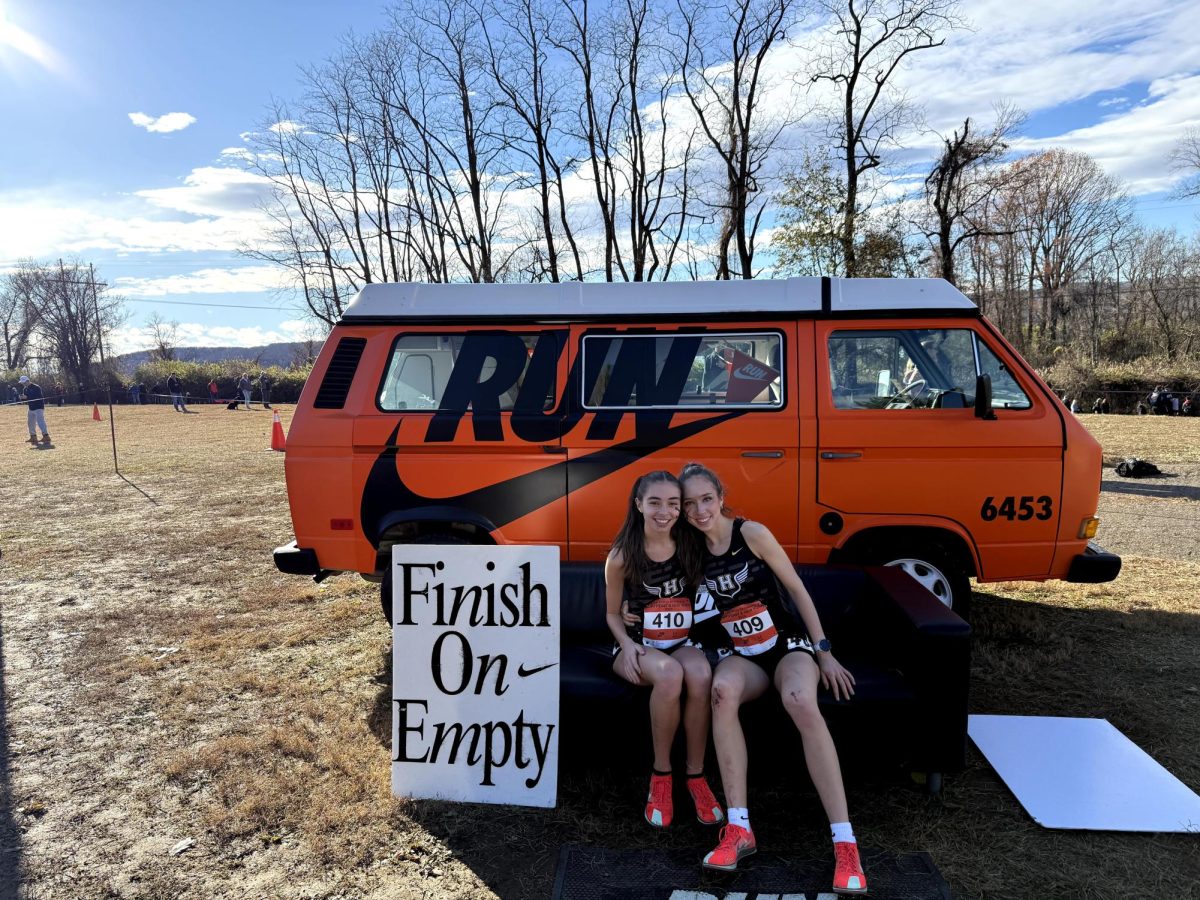
For Schwartz, Hackley was more than just a school; it was a community in which she was deeply involved. She ran cross-country, played squash, co-edited the Dial, and volunteered through Breakfast Run and the Blythedale Children’s Hospital.
But it was the Dial, specifically, where she began to step forward as a leader.
“My best friend and I were both up for the job [Editor in Chief of the Dial], and we were pretty competitive, so we knew that our friendship might suffer if one of us got it and the other didn't. So we decided to apply together, which I think is not necessarily a conventional thing, but we did it together, and we had such a blast.”
The difference between the Dial when Schwartz was at the helm and the Dial of today is night and day. Editors worked to print out monthly issues for the student body to read.
“Being in the Dial office was a really safe space for me,” Schwartz said. “We didn’t have a website—we printed the paper.”
Layout nights, the day before a new issue, often stretched late into the evening. “We would kind of just crash in the computer lab,” she said. “We had these marathon layout sessions using InDesign—we’d get pizza and be kind of silly.”
During one of these sessions, though, Schwartz got her first taste of a real-world story. The Rangers were practicing on Hackley’s campus when Sean Avery got into an argument turned fight with one of the coaches. Immediately, Schwartz had to tear up the front page and add an article about Sean Avery being asked to leave campus.
“That was the first time I realized how fun it was,” Schwartz said. “Something is happening, and you’ve got to figure out what it is.”
In addition to learning how to tell stories, Schwartz credits the Dial and advisor Dr. Bonen, specifically, with “helping me so much with my writing.” He gave her “a really strong foundation in writing and editing” when she went to college.
Schwartz graduated from Hackley in 2010 and enrolled in Dartmouth as a history major. Entering college, Schwartz felt that high school left her “super prepared”, as the rigorous structure of Hackley’s academics, as well as extracurricular activities, was harder in some ways than her college experience.
“I started at the college paper in part because college was pretty unstructured, and I was used to the routine of Hackley,” said Schwartz. “Because I had that muscle memory from high school, it paved the way for me to do it in college, and I figured along the way I really wanted to be a reporter.”
That realization, coupled with the connections Schwartz had acquired from her time at Dartmouth and Hackley, led her to her first internship in the Washington Bureau of The Wall Street Journal during the summer of 2014. Following this, Schwartz was hired as a junior national security reporter and then took a job covering the State Department.
After she proved herself, Schwartz had the opportunity to serve as the chief correspondent covering the Israel-Palestine territories on the ground from 2018 to 2021.
“I always felt very confident, like I had a lot of people who had my back and supported me,” Schwartz said. “I knew my Hackley community was reading from afar, and my friends and their parents and families were some of the most supportive of me, my work, and my travel.”
Working overseas, Schwartz began to see the human consequences of the decisions made by the policymakers she once covered in Washington. Reporting in Gaza showed how those decisions affect the most vulnerable people living through conflict.
“Spending time with people who’ve lost loved ones and lost their homes—seeing all that destruction—was one of the most emotionally challenging things I’ve ever done,” Schwartz said.
For one story, Schwartz wrote about a failed IDF strike that collapsed a Gaza apartment building. She had the opportunity to talk to the civilians who had their lives upended, as well as the IDF general who authorized the strike.
“The people who make decisions are people who think they’re doing what’s right,” Schwartz said. “And on the other side are civilians who are swept up in it.”
This new perspective leads to the stories Schwartz is most proud of today.
In one piece, Schwartz wrote about how public sentiment for Israel is divided between older and younger people. She focused on this issue in the United States and Israel, both places she had lived and worked in.
“I was able to wrap all of my reporting experiences together,” Schwartz said.
While the generational divide piece showed her ability to analyze broader trends, her piece on American real estate developer Steve Witkoff showed how her work could have an immediate impact.
Witkoff went under the radar to most of the public, but had taken a “broker” role in various international domains. The goal was to shed light on this to the public, but the piece drew heavy criticism from the executive branch, including Vice President JD Vance.
Despite any backlash, Schwartz views this piece as a prime example of her job as a reporter. She wants to ferret out information the government may not want the public to know and to change the conversation through original reporting. For Schwartz, the intense reaction was merely a sign she had done exactly that.
Though Schwartz’s reporting reaches the highest levels of government and discussion, she remains grounded in the people and communities that shaped her long before she worked in Washington.
Over a decade after graduation, many of her closest friendships still trace back to the hilltop.
“It means a lot, most especially because I have this incredible, very, very close group of friends who I met there and continue to be some of my best friends,” Schwartz said. “We reminisce so fondly about high school.”
Even through moves, careers, and major milestones, she and her friends continue to grow together. “We’ve gone through a pandemic, I’ve lived overseas, we’ve got weddings, kids, families,” she said. “And these are still some of the deepest friendships in my life.”
Looking forward, Schwartz is keenly focused on the health of journalism. Issues such as declining trust in media and artificial intelligence are existential threats to the industry.
“I’m really worried about media literacy and how people are getting their news,” Schwartz said. “There’s so much AI slop floating around the internet, and I just worry about how people understand what a trusted source of news is.”
On a more personal note, Schwartz wants to keep reporting and telling stories from places where policy and people intersect. She said she wants to return to Ukraine, cover the upcoming Israeli elections, and even report on Air Force One. She also wants to give back to the Hackley community that set her on her path.
“If I can be a resource or a sounding board to a student who’s there now and wants to be a journalist, that would mean a lot to me,” Schwartz said. “When I was at Hackley, I don’t think I had ever met a professional working journalist. But I had teachers who could see that I was really into it and fostered that love.”