























When most people think of history in high school, they imagine a class with a set curriculum full of long lectures and excessive dates to memorize. What you don’t usually see is students connecting their personal passions to historical events and exploring them on their own. This is exactly what makes Hackley’s Independent Research in History (IRH) course, taught by history teacher Stephen Fitzpatrick, so unique.
The Class:
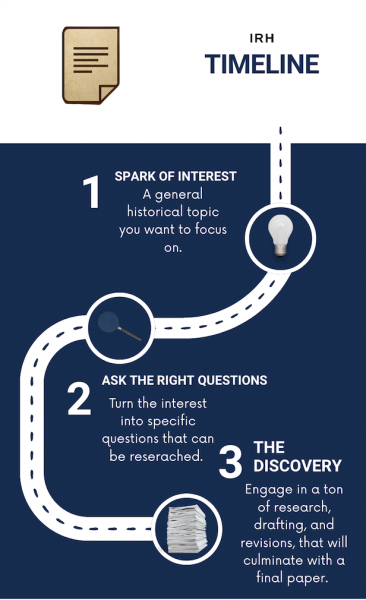
Rather than following a typical predetermined syllabus, students in IRH design a year-long historical investigation that combines rigorous research and deep historical interest. The class meets three times a cycle and culminates with a 10,000-15,000-word paper presented at Hackley’s end-of-year research symposium.
The class has evolved over the past few years to meet the influx of students who want to take it.
“One of my goals this year was to try to lock in certain checkpoints during this year where I could be much more confident that students were where they needed to be in terms of their work,” Mr. Fitzpatrick said. “So that’s kind of how I’m trying to evolve the course into something a little more rigorous—a little more organized and structured.”
This can be especially seen in the new timing of each checkpoint.
“In the past, they didn’t really start writing their paper until we were on spring break,” Mr. Fitzpatrick said. “I don’t want that — I want to see some work done before we even get to the middle of January.”
However, to reach the point where students can begin writing their papers, they must first undertake the task of refining and focusing on specific research questions. Being interested in something like World War II isn’t enough; from a research perspective, the focus has to be narrower.
Research Process:
Once you have a question, knowing where to start can be a challenge. This year, students have been using the deep-research function on various AIs to quickly find hundreds of sources on their specific topic.
“The million-dollar question is — how do you go from finding all that good information to actually analyzing it? You have to understand where it’s surfaced. Is an LLM pulling from its training data or a live web connection you can check?” said Mr. Fitzpatrick.
Students are working on learning how to navigate and understand what a good and bad source is. Although AI makes research more efficient, students still need to directly engage with sources to ensure they are reliable.
Personal Projects:
For senior Phillip Ianchulev, his project has given him the chance to connect to his family’s history.
“Both my parents are from communist Bulgaria,” Phillip said. “They both lived there and were born in the 1970s, and they had their education there. My dad was able to leave Bulgaria because he won an academic award, and my mom came after. They don’t really talk about what their experiences were, and neither do my grandparents. I want to use this as an opportunity—to interview my grandparents, understand more about their experiences, and other people’s perspectives.”
Phillip’s research focuses on secondary schooling in Bulgaria during the communist era. He has discovered that his family has primary sources like “handmade gradebooks” that can help his research. He is hoping to see how this schooling shaped the lives of those in it, both positively and negatively.
“My grandparents have different perspectives on communist-era schooling. Some of them believed that it was really bad for them, and it really hurt them. Some of them believed that there were some benefits to it. It’s important to also address the other perspective that usually gets overshadowed by propaganda and other news media,” said Phillip.
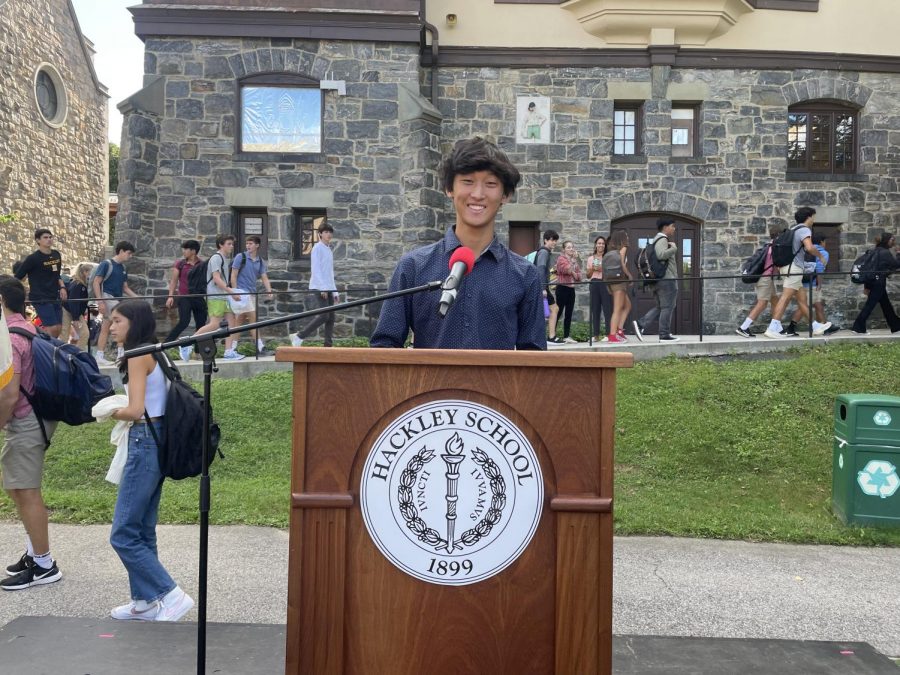
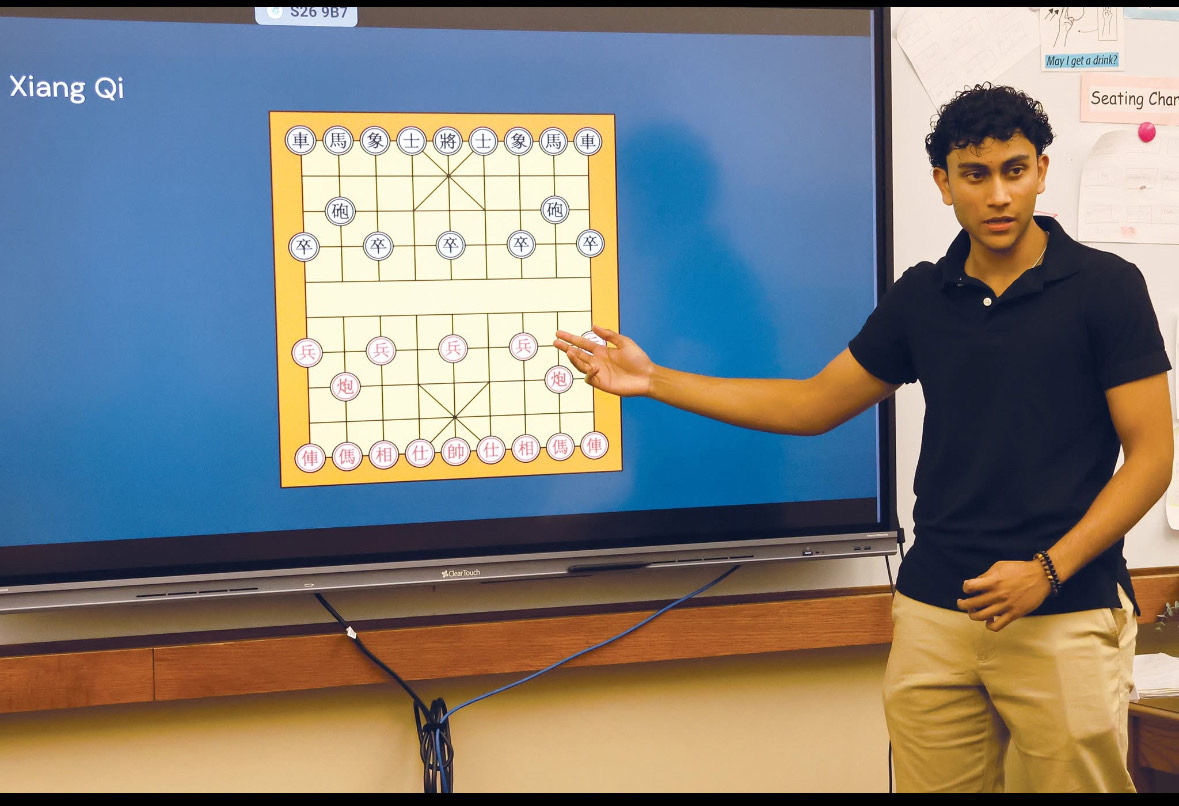
Senior Rohan Krishna completed the IRH class last year. His project took his lifelong passion for chess and looked at it through a historical lens over the past 2000 years.
“My topic was looking at chess because that’s a game that I’ve played a lot,” Rohan said. “It was kind of looking at how a game that’s been around for over 2,000 years, even longer honestly, 3,000, has been able to not only survive but thrive throughout history—how it’s changed, how the changes reflect the societal changes of the time, the norms, [and] how when different pieces evolved and changed, it reflected societal hierarchy differences.”
Unlike most students, Rohan had begun his research and writing process over the summer, so when he came to class, he already had a draft. Although he had months of work done, he was nowhere near finished.
“The first draft I gave Mr. Fitz, he absolutely tore it to shreds,” Rohan said. “Which, looking back, was probably the best thing he could have done for me because that draft had a lot of holes that needed to be fixed.”
His experience shows how the course allows for so many different topics to be explored to their fullest. Other projects include current senior Oren Wildstein, who is looking at companies during various economic crashes, and Jack Perlman ’24, who looked into Thomas Paine’s Common Sense.
“If you follow the deadlines, IRH is an easy and rewarding class. But if you don’t keep up with it, it can quickly become the hardest class. I just say keep up, keep on top of it, and honestly just have fun because it’s a really fun class too,” Rohan said.
IRH proves that the highest level of historical learning is not about memorization, but about being able to ask questions that matter and then actually trying to find the answers.