









































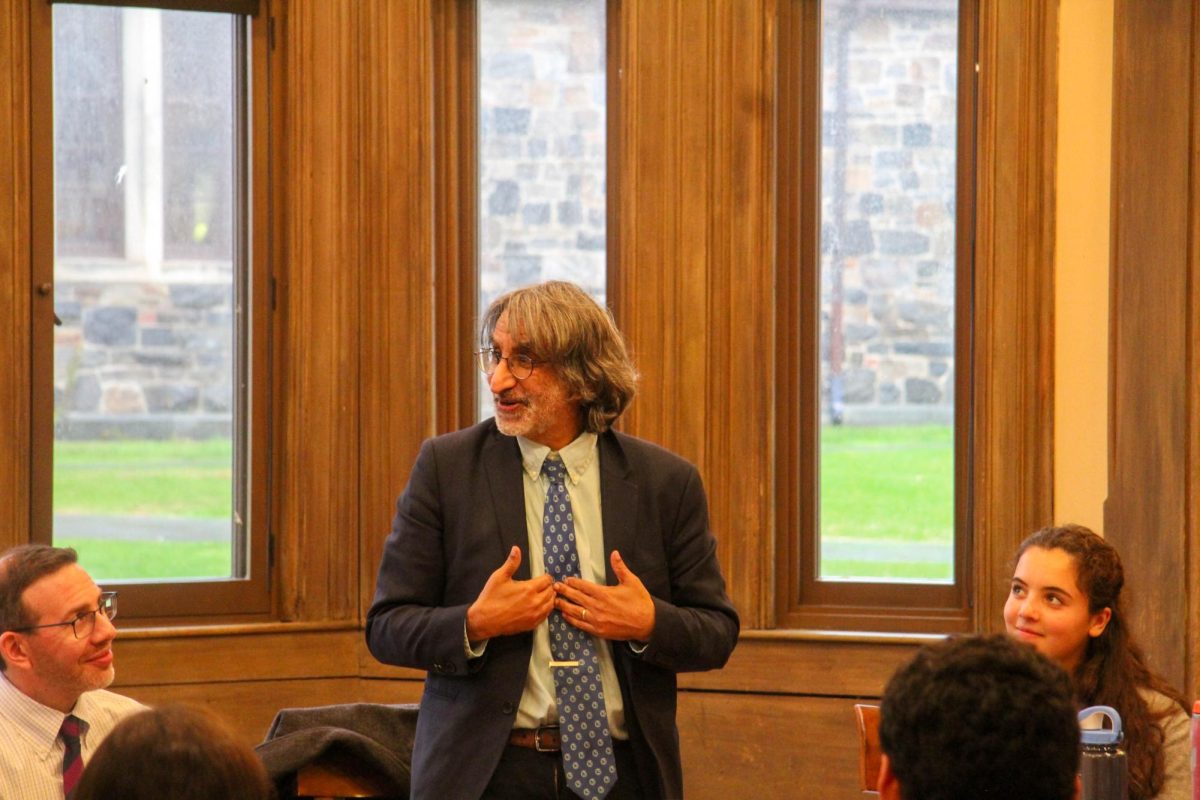
“Unless every generation understands the Constitution, it dies,” Akhil Amar says.
Professor Amar is the second-most-cited person by the United States Supreme Court. He is also a professor of Law and Political Science at Yale University and a highly accomplished author, having published seven books.
Professor Amar visited the Hackley hilltop twice over the past three years. Each time, his main goal was for students to leave the room with a greater understanding of the Constitution and how to conduct effective discussions concerning it, fortifying democracy itself.
The constitutional adoration that led Professor Amar to writing and teaching was not kismet. It was built on the immediate understanding that the Constitution offered him something unique.
“On the day I’m born, our Constitution gives me a great gift. It makes me a citizen of the United States,” said Professor Amar.
He is the first generation of his family born in America. Throughout his life, he observed that many of his cousins who did not live in the country had less fortunate lives compared to his. This cemented his gratitude to the Constitution that offered him this opportunity.
While Professor Amar was at Hackley, he regularly reminded students that constitutional conversation does not end when he leaves the building. There are readily available sources that help improve constitutional literacy every day. These include reading the Constitution itself, primary source materials such as the Federalist Papers and the Gettysburg Address, Professor Amar’s own podcast–Amarica’s Constitution– and reading books about the Constitution.
Thanks to the Jeffery A. Libert ‘73 Endowment, Professor Amar’s own books have been gifted to students. His trilogy, two of the three completed, teaches the readers about the Constitution and explores how it evolves. The books’ titles highlight this. The first is named The Words that Made Us: America’s Constitutional Conversation, 1760-1840, and the second is called Born Equal: Remaking America’s Constitution, 1840-1920.
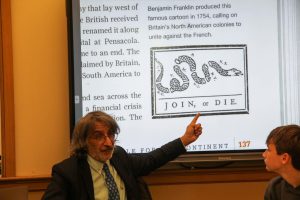
Professor Amar in a tenth grade United States History Class. The majority of the class was spent discussing Benjamin Franklin’s use of the “Join or Die” cartoon, which was one of the first political cartoons in America. “Professor Amar talks about Franklin a lot in his 1st book because of Franklin’s use of the join or die political cartoon,” Mr. Bass said.
Throughout his visit in late October, Professor Amar demonstrated how constitutional questions are rarely disconnected from modern-day political issues. This can include heavy topics such as the overturning of Roe v. Wade, which was the most talked-about case during the day.
This was apparent at the Roundtable and at the select few classes he attended. These classes included Independent Research in History, United States History, and a joint United States Government and American Law class. During the Roundtable, Professor Amar spoke at length about the doctrine called “substantive due process” and its role in Roe v. Wade. Substantive due process is a legal concept that the Constitution protects certain rights even if they are not explicitly written, and has been the basis for several impactful Supreme Court decisions.
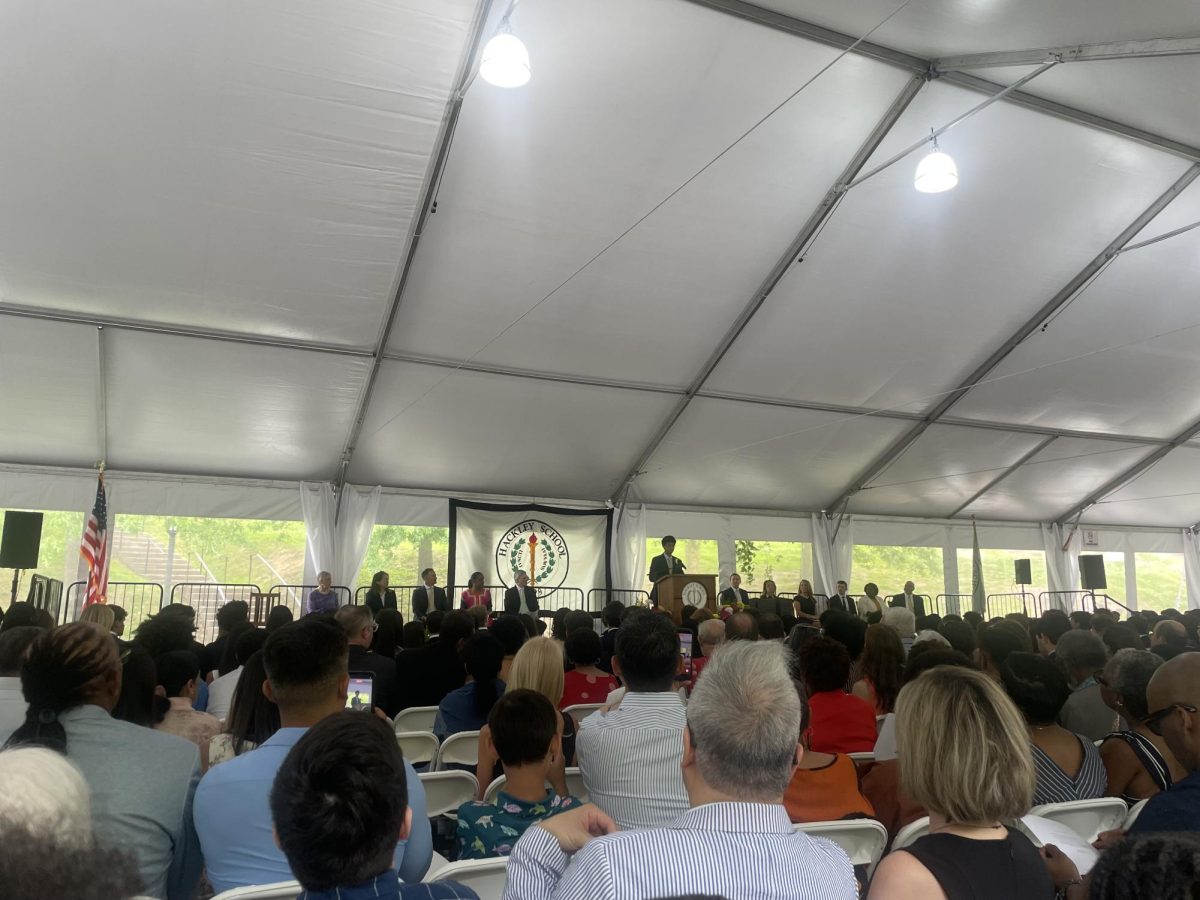
The energy at the lunchtime Roundtable was palpable, demonstrated by students’ animated engagement in the constitutional discussion.
Ella Ferrari, a junior and taking the United States Government class, commended Professor Amar’s ability to have a political argument without any personal opinions.
“However, he argued it differently. He’s also pro-choice, but he argued it constitutionally, which I think is really important, and not a lot of people can do that,” Ella said about Professor Amar’s Roe v. Wade argument.
Norah Mott, a freshman who is deeply passionate about law and politics, called the experience at the Roundtable a “golden time” and remarked how special it was to have a Professor from one of the top law schools, Yale, speaking to Hackley students.
The point of bringing speakers to Hackley is not to have every student agree with every opinion. Michael Bass, a history teacher and friend of Akhil Amar, explained that the motivation behind bringing diverse people to Hackley was to expose students to different ideas.
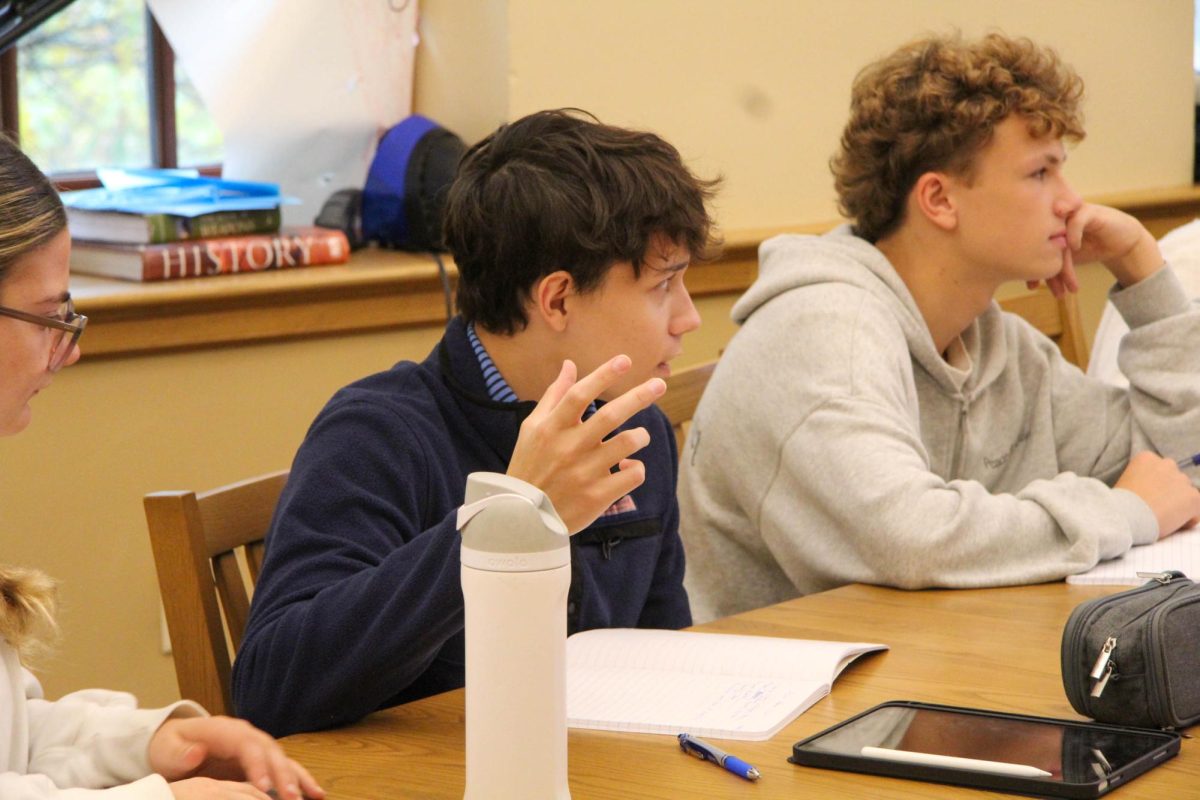
Alfie Adams, William Sevilla, and Sarah Sichel-Outcalt, in the tenth grade United States History Class that Professor Amar was speaking in. William’s active participation and the notes laying in front of all three demonstrate the engagement of the students during his visit. “Americans have very different views about all sorts of things, and they have to discuss them,” Professor Amar said.
“[Students] have a right and obligation to think about what the speaker says, examine it critically, and think about whether they agree or disagree,” Mr. Bass said on the role of students while listening to an invited speaker.
This critical thinking was evident among the students who were in class or at the Roundtable with Professor Amar.
Ella believes that the government should balance between Constitutional reasoning and personal morality. While Professor Amar feels that Constitutional and political views should be completely separate.
Professor Amar used some personal instances to show this; despite being pro reproductive choice, he is not convinced by the legal analysis in Roe v. Wade. “I don’t think it made a good Constitutional case,” said Professor Amar.
Another example from Professor Amar is on gun regulation. “Take guns. I don’t have a gun. But that’s my personal opinion, but constitutionally I think there is a right to have a gun in the home for self-protection,” said Professor Amar.
Both Mr. Bass and Professor Amar demonstrated to students that smart people, in school and in the government, have the right to disagree on constitutional interpretations. But, after understanding both sides, it is knowledgeable discussions on those opinions that lead to change.
“I would want them to read the Constitution, so they’re literally on the same page, and I’d want them to read some background materials on the Constitution, that could help both sides understand it better,” Professor Amar says, talking about effective discussions.
“I shared that I disagreed with several things that Professor Amar said during his visit, and I think that gave students the space and confidence to share their own reflections,” Mr. Bass said. Modeling the discourse that Professor Amar strived to instill in students.
“The conversation will continue,” Professor Amar says, certain that understanding will live on through the next generation. Especially by student initiative.


